
Why Your Frozen Fish Is Worth More Than You Think: The Cold Chain Story
That frozen fish worth more than you think. Discover how cold chain tech keeps meat & seafood fresh from coast to kitchen—and why it's changing fast.
1/4/20268 min read
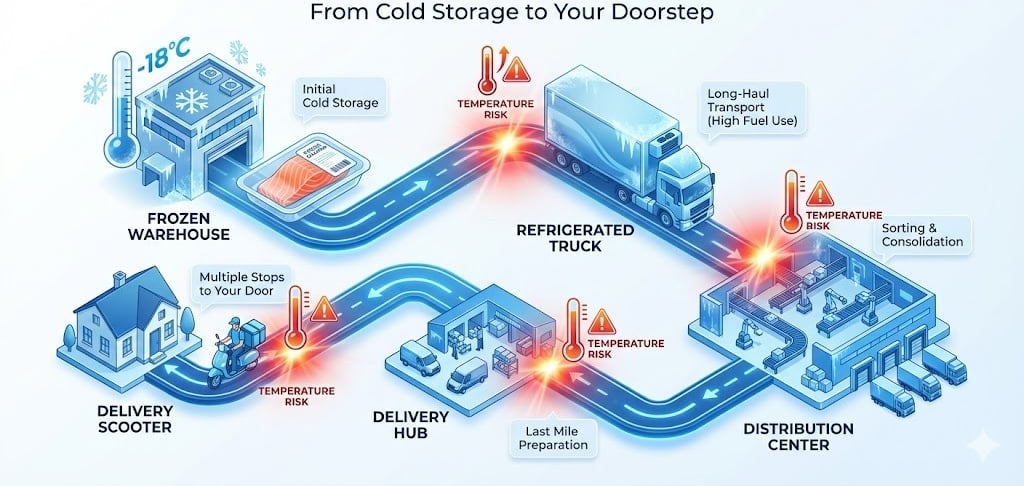
Remember when buying meat meant going to your local butcher or supermarket? Those were simpler times for cold chain logistics. Now? Companies like Licious, Captain Fresh, and Bonsaro are promising to deliver restaurant-quality seafood and meat directly to your doorstep. That changes the entire game.
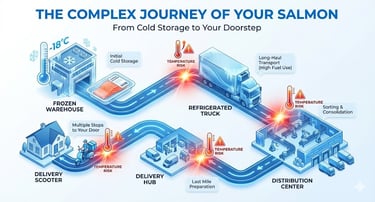
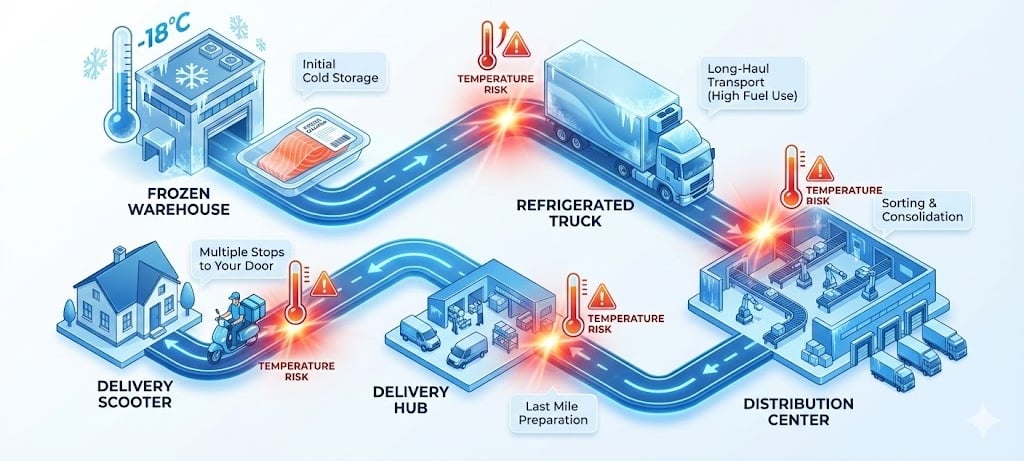
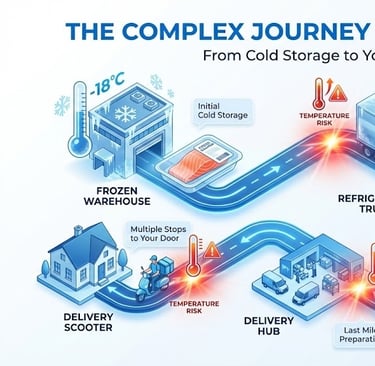
Let's follow one delivery to understand the complexity. That pack of salmon you ordered online left a cold storage facility at -18°C. It was loaded into a refrigerated truck (which, by the way, uses 25% more fuel than regular trucks). Then it might have gone to a distribution center, got loaded onto another truck, possibly sat in a delivery hub, then finally made it onto a delivery vehicle that's stopping at twelve other houses before yours.
At each transfer point, there's a moment sometimes just seconds, sometimes minutes where the temperature fluctuates. In the industry, they call this "temperature abuse." It sounds dramatic, but it's accurate. Each fluctuation, each warm moment, degrades the product. The texture changes. The color shifts. The taste becomes... off. And bacteria? They're having a field day.
The Last Mile Is the Hardest Mile
Urban delivery drivers face a unique nightmare scenario. Imagine you're delivering frozen goods in the middle of summer in a busy city. You've got 15 stops to make. Every time you open that vehicle door every single time the temperature inside drops. By your tenth delivery, the temperature fluctuates wildly. Your refrigeration compressor is working overtime, guzzling fuel, and your last few customers? They're getting products that have been playing temperature roulette for the past three hours.
Traditional refrigeration units can maintain temperature, sure. But they're designed for continuous cold storage or direct point-to-point delivery. They're not built for the stop-start reality of modern urban delivery.
And then there's the nightmare scenario every delivery company dreads: the compressor fails. Or the engine breaks down. Or there's a massive traffic jam on a 40-degree day. What happens to thousands of dollars worth of product sitting in a vehicle that's slowly becoming a very expensive oven?
Enter the Unlikely Hero: Wax (Sort Of)
This is where the story gets genuinely fascinating. The solution to this multi-billion dollar problem isn't some complicated piece of machinery. It's something called Phase Change Materials, or PCMs. Think of them as super-smart ice packs that have been to engineering school.
Here's how they work: PCMs are materials that absorb and release thermal energy when they change state like going from solid to liquid or liquid to solid. But unlike regular ice that melts at 0°C, these materials can be engineered to change state at exactly -18°C, or +4°C, or any temperature you need.
The magic happens during that state change. When a PCM is melting (or freezing), it absorbs massive amounts of energy without changing temperature. This means it can hold a consistent temperature for extended periods sometimes up to 72 hours without any power source at all.
The market clearly sees the potential. PCM technology, valued at $729 million in 2025, is expected to more than double to $1.64 billion by 2030. That's a 17.58% annual growth rate, which in the boring world of industrial materials is basically rockstar status.
The Real-World Impact
Let me tell you about what happened when one meat delivery company in India implemented PCM technology. They were losing money hand over fist on their urban deliveries. Customer complaints were mounting. Product waste was killing their margins.
They installed PCM-based cold plates in their delivery vehicles and started using PCM gel packs in their insulated bags. The results? They cut product spoilage by 35%. Their refrigeration energy costs dropped by 40%. They extended their delivery radius by 25% because they could now reach neighborhoods that were previously too far away. And customer satisfaction? Shot up by 42 percentage points.
But here's the kicker: they achieved ROI in just 18 months. After that, it was pure savings.
It's Not Just About Technology
The thing about cold chain solutions is that technology is only part of the equation. The human element matters just as much.
I spoke with a logistics manager for a seafood company who put it perfectly: "You can have the most advanced PCM system in the world, but if your delivery driver doesn't understand why pre-conditioning the cold plates matters, or if your warehouse staff doesn't follow proper handling procedures, you're still going to have problems."
Training matters. Understanding the 'why' behind the procedures matters. Creating a culture where everyone from the warehouse worker to the driver to the person unloading at the distribution center understands that they're not just moving boxes they're maintaining a critical temperature envelope that keeps food safe.
The Science of Staying Cool
Let's get a bit technical for a moment, because the temperature requirements are surprisingly specific and there's good reason for it.
Fresh meat and seafood need to stay between 0°C and 4°C. Why that range? Because bacteria that cause foodborne illness multiply slowly at those temperatures slow enough that the product stays safe for several days. The CDC reports that 48 million Americans get food poisoning every year, and improper temperature control is a major culprit.
For frozen products, the magic number is -18°C or lower. At that temperature, bacterial growth essentially stops. Not slows down stops. But here's something interesting: not all frozen products are created equal. Fatty fish like tuna and mackerel need to be kept at -24°C or colder because fat oxidizes and goes rancid even at standard freezing temperatures.
There's also a movement in the industry called "Move to -15°C." It's exactly what it sounds like storing frozen goods at -15°C instead of -18°C. The energy savings are substantial: 10-11% reduction in power consumption. The question everyone's debating is whether those three degrees compromise food quality. Early research suggests it doesn't, but the jury's still out.
When Things Go Wrong
Let's talk about what happens in that "danger zone" between 5°C and 60°C. Bacteria don't just grow they throw a party and invite all their friends. In this temperature range, bacterial populations can double every 20 minutes. That pack of chicken that spent two hours in the danger zone? The bacterial count just increased 64-fold.
This is why regulatory bodies are getting serious. In the US, the FDA's Food Safety Modernization Act Section 204 kicks in fully by January 2026, requiring detailed electronic records throughout the entire food supply chain. Europe has similar regulations. The days of "trust us, we kept it cold" are over. You need data, timestamps, and proof.
The Future Is Cold (And Smart)
If you think cold chain technology today is impressive, wait until you see what's coming.
Imagine sensors so cheap they're essentially disposable, yet sophisticated enough to track temperature, humidity, and location throughout an entire journey. These battery-free sensors are already being tested. They harvest energy from ambient radio waves and can transmit data for months.
Or consider AI systems that don't just monitor temperature they predict problems before they happen. By analyzing thousands of deliveries, weather patterns, traffic data, and historical temperature variations, these systems can tell you: "Route 7 has a 34% chance of temperature excursions on hot Tuesday afternoons. Recommend alternative routing or additional PCM backup."
Blockchain is entering the conversation too. Imagine a world where you can scan a QR code on your seafood package and see the complete, tamper-proof temperature history from the moment it was caught to when it arrived in your kitchen. That's not science fiction it's being tested right now.
The Sustainability Angle Nobody Talks About
Here's something that should bother us all: refrigerated transport uses 25% more fuel than regular transport. When you're moving millions of shipments annually, that's an enormous carbon footprint.
PCM technology addresses this in a clever way. By providing thermal backup, vehicles don't need to run their compressors constantly. The compressor can shut off during stops, turn off entirely during short trips, or work at lower capacity. Some operations report 40% reductions in refrigeration energy use.
And here's the multiplier effect: less fuel consumption means fewer emissions, which means less contribution to climate change, which means fewer extreme heat days, which means... easier temperature control for cold chain logistics. It's a virtuous cycle.
What This Means for You
If you're in the business of handling perishable goods, here's the uncomfortable truth: your competition is already exploring these solutions. The companies that figure out cold chain excellence aren't just saving money on waste they're expanding their geographic reach, improving their product quality, and building customer loyalty through reliable delivery.
The initial investment can seem daunting. PCM systems, IoT sensors, training programs it all adds up. But the payback period is typically 12-24 months, and after that, you're operating with better margins than you had before.
If you're a consumer, this matters to you too. That increase in the quality of delivered food you've noticed over the past few years? That's cold chain innovation at work. And it's going to keep getting better.
The Bottom Line
The cold chain industry is at an inflection point. E-commerce has created demand for capabilities that didn't exist five years ago. Climate change is making temperature control harder. Regulations are getting stricter. And yet, the solutions exist and they work.
Phase Change Materials aren't a magic bullet, but they're close. Combined with smart routing, real-time monitoring, proper training, and well-designed backup systems, they create a resilient cold chain that can handle the complexities of modern distribution.
The companies winning in this space aren't necessarily the ones with the most money or the biggest trucks. They're the ones who understand that cold chain management is a system a complex interplay of technology, people, processes, and planning. Get all those elements right, and you can deliver a perfectly frozen fish to someone's doorstep three states away on the hottest day of summer.
And that frozen fish? It's worth a lot more than you think. It represents a triumph of engineering, logistics, and human ingenuity over the fundamental laws of thermodynamics.
Not bad for a Tuesday afternoon delivery.
Why Your Frozen Fish Is Worth More Than You Think: The Cold Chain Story
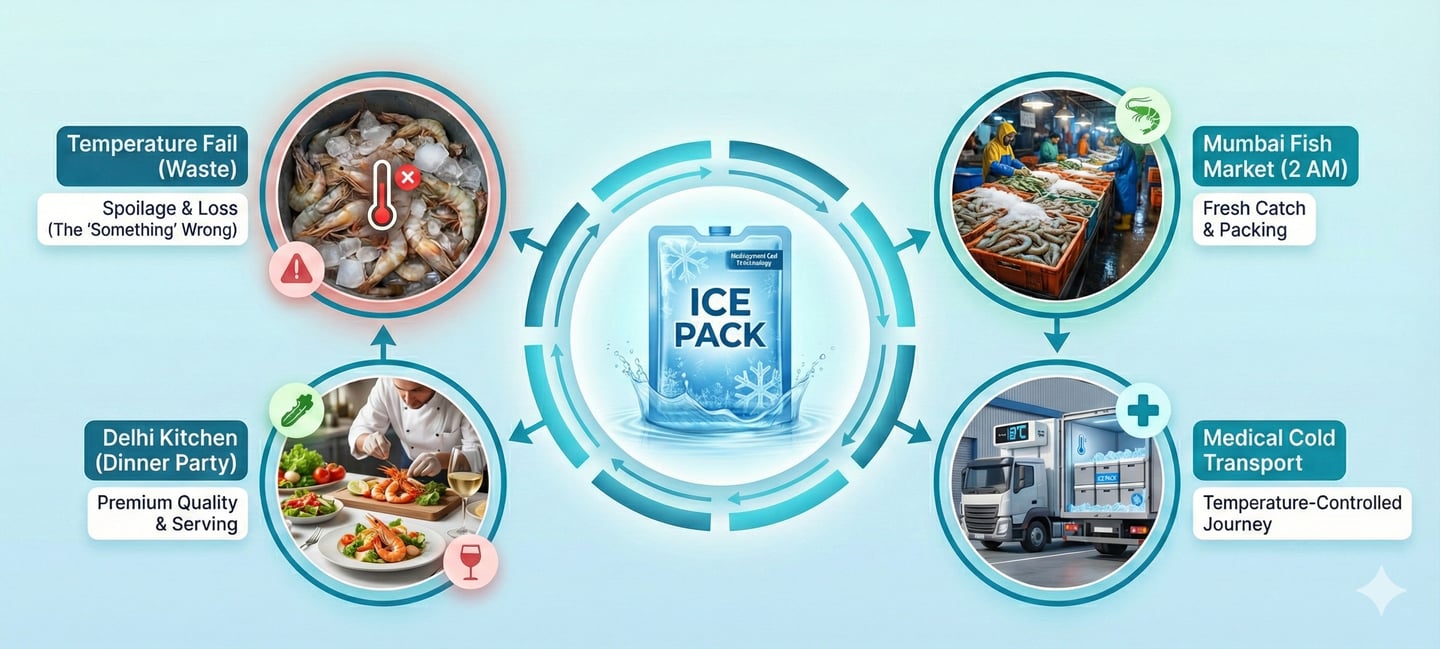
Picture this: It's 2 AM at a bustling fish market in Mumbai. A shipment of fresh prawns has just arrived from the coast, packed in ice and ready to begin their journey. By tomorrow afternoon, some of these prawns will be sitting in someone's kitchen in Delhi, still fresh enough to serve at a dinner party. Others? They'll end up in the trash because somewhere along the way, something went wrong with the temperature.
That "something" is what keeps supply chain managers up at night.
The Invisible Problem That's Costing Billions
Here's something most people don't think about when they grab that pack of frozen chicken from the grocery store: that product has been through an elaborate dance of temperature control that would make a Swiss watchmaker jealous. And when that dance goes wrong? The numbers are staggering.
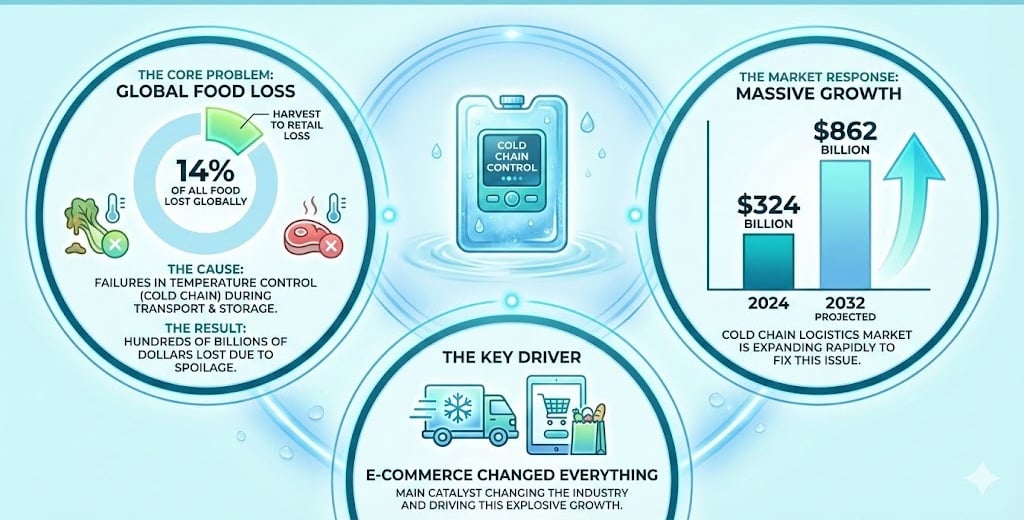
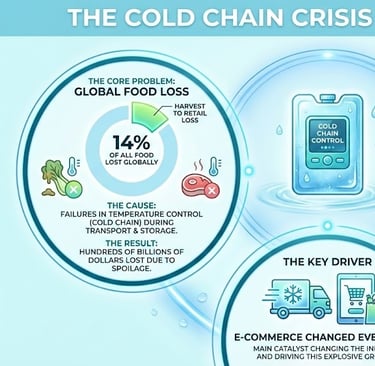
Globally, we lose about 14% of all food between harvest and retail. That's not a typo. Fourteen percent just... disappears. Much of it spoils because someone, somewhere in the chain, couldn't maintain the right temperature. We're talking about hundreds of billions of dollars literally melting away.
But here's where it gets interesting. The cold chain logistics market isn't shrinking in response to this challenge it's exploding. From $324 billion in 2024, it's projected to hit $862 billion by 2032. Why? Because e-commerce changed everything.
When Your Dinner Takes a Road Trip
SINHA THERMAL ENERGY PRIVATE LIMITED © 2025. All rights reserved.
Sinha Thermal Energy is an ISO 9001:2015 certified material science startup specializing in the research, development, manufacturing, and supply of Phase Change Materials (PCMs) and related products


SINHA THERMAL ENERGY PVT LTD
Corporate Identification Number
(CIN):-U20297BR2019PTC042242
GSTIN:-27AADCF7558C1ZL
IEC:-AADCF7558C
Terms & Conditions